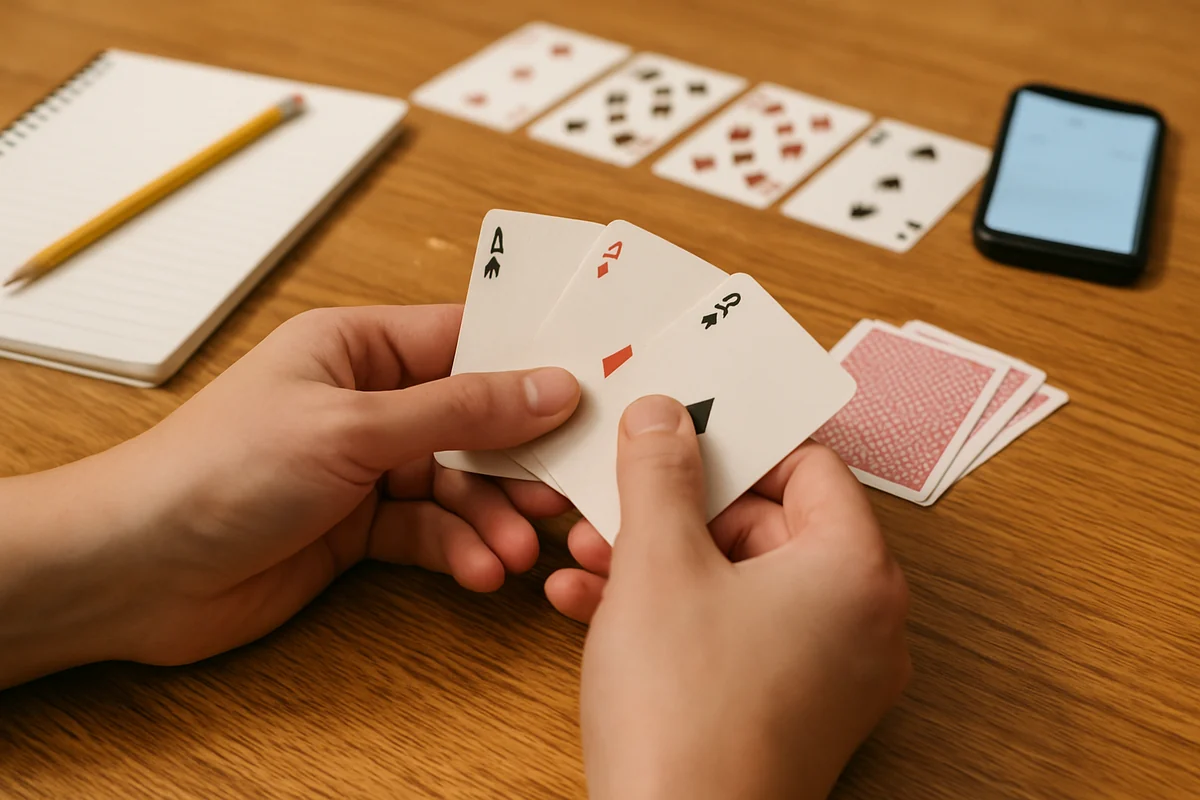
A good discard balances three questions: is this card still useful to me, can it help an opponent, and is it costly if the round ends?
How to Choose the Right Card to Discard in Rummy
In the game of Rummy, the decision to discard a card can significantly impact the course of the game. A good discard balances three essential questions: is this card still useful to me, can it help an opponent, and is it costly if the round ends? This guide will help you evaluate which card to discard considering value, combination potential, visible cards, and the timing of the round.
In Brief: Five Questions Before Discarding
Before making a decision on which card to discard, it is helpful to ask yourself five key questions:
- Does this card contribute to a potential combination?
- Could this card be beneficial for an opponent?
- What is the value of this card in the context of the current round?
- Do I have other cards that could better complete my hand?
- What is the timing of the round: beginning, middle, or end?
These questions help structure your thinking and optimize your discard strategy.
Identifying the Least Useful Cards in Your Hand
To choose a card to discard, start by identifying those that are least useful in your hand. An isolated card, for example, may seem of little value, but it could become useful if you draw a complementary card. Conversely, a card that does not fit into your current combinations should be considered for discarding.
Generally, cards that do not contribute to sequences or sets are good candidates for discarding. It is important to keep in mind that each card has potential that can change over the course of the game.
Assessing the Risk of Helping an Opponent
A crucial aspect of discarding is assessing whether the card you are giving up could help an opponent. For example, if you discard a card that completes a sequence you have observed in an opponent's hand, you are giving them an opportunity to score points. In many games, it is therefore essential to keep an eye on the visible cards and consider the impact of your discard.
To minimize this risk, it may be wise to discard cards that are less likely to be useful to your opponents. This requires careful observation of their plays and tendencies.
Considering the Value of Remaining Cards
The value of the remaining cards in your hand plays a significant role in your discard decision. Numbered cards are often worth their face value, while face cards are generally worth 10 points. The Ace can have variable value depending on your table's conventions, which can influence your choice.
At the end of the round, a costly card becomes riskier to keep. If you are close to the end, it may be better to get rid of cards that could lead to a high penalty in case of defeat.
Adapting Your Discard to the Timing of the Round
The timing of the round also influences your discard decision. At the beginning of the round, you may be more flexible in your choices, as you still have the opportunity to draw cards that could complete your hand. In contrast, in the middle or at the end of the round, the pressure increases and every card counts more.
Here is a table summarizing the considerations to take into account based on the timing of the round:
| Timing of the Round | Considerations |
|---|---|
| Beginning | Flexibility in choices, possibility to draw useful cards. |
| Middle | Evaluate visible cards, anticipate opponents' moves. |
| End | Minimize risks, discard costly cards. |
Comparing Multiple Discard Decision Examples
To illustrate these concepts, let’s examine three discard scenarios:
- Scenario 1: You have an isolated card that does not fit into your combinations. Discarding this card may be wise, especially if it poses no risk to your opponents.
- Scenario 2: You have a costly card, but it could complete a combination. In this case, it may be better to keep it unless you are close to the end of the round.
- Scenario 3: You have a potentially dangerous card for your opponents. If you think it could help them, it is often better to discard it, even if it means giving up a potential combination.
Common Mistakes
When discarding, certain mistakes are common. Here are some of the most frequent ones and how to avoid them:
- Discarding without thinking: Take the time to evaluate the value of your card and its potential impact on the game.
- Ignoring visible cards: Keep an eye on the cards discarded by your opponents to better anticipate their moves.
- Holding onto costly cards for too long: Regularly assess the necessity of keeping high-value cards, especially at the end of the round.
- Not adapting your strategy: Every game is unique; adjust your choices based on scoring rules and your table's conventions.
FAQ
Should I discard an isolated card or a costly card?
The decision depends on the situation. An isolated card can become useful with a draw, while a costly card can lead to penalties if the round ends. Evaluate the potential of each card and the timing of the round.
How can I avoid helping an opponent?
To avoid helping an opponent, observe the cards they play and those they discard. Avoid discarding cards that complete their combinations.
Does the decision change at the end of the round?
Yes, at the end of the round, every card counts more. It is often better to get rid of costly cards to minimize potential penalties.
How do I take scoring rules into account?
Scoring rules vary according to your table's conventions. Make sure to understand how cards are valued and adjust your discard strategy accordingly.
What are the best practices for discarding?
Best practices include evaluating the usefulness of each card, observing opponents, and adapting your strategy based on the timing of the round.
To deepen your knowledge of Rummy and test the decision grid during a game, feel free to visit RamiPlus.